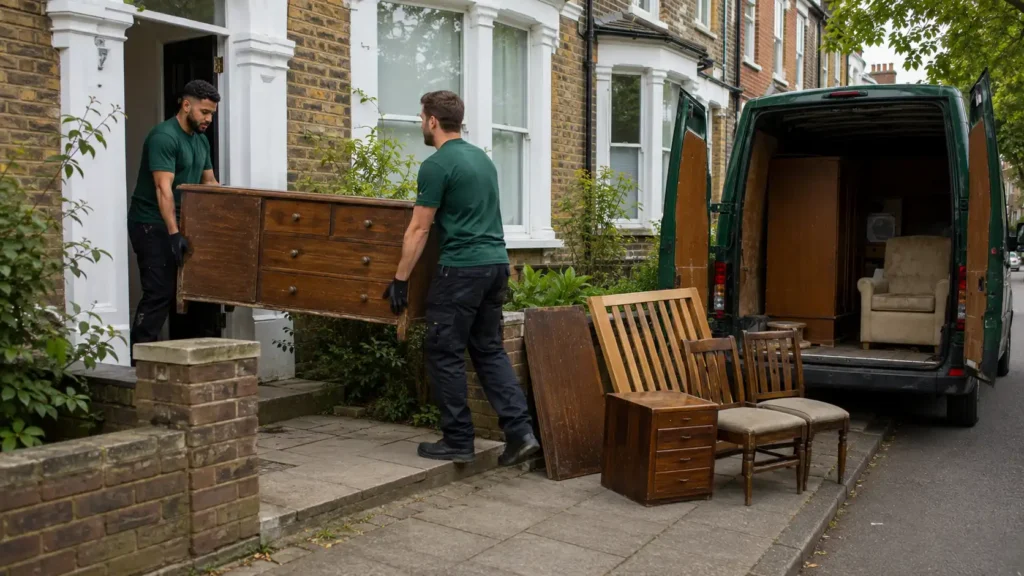
Getting rid of an old sofa, wardrobe, bed or dining table does not necessarily mean hiring a skip. In many cases, furniture can be donated, sold, taken to a reuse and recycling centre, collected by the council or removed by a private rubbish clearance company.
For households in Lewisham, choosing the right option usually depends on the condition of the furniture, its size, how much needs clearing and whether someone can move it out of the property themselves.
A skip can be useful for some larger projects, but it is not always practical for disposing of a few bulky household items. Properties with restricted parking, flats without driveways and homes on busy streets may also make skip placement more difficult.
Where unwanted furniture needs to be carried from the property and taken away in one visit, arranging a local rubbish removal service can provide a straightforward alternative.
What Is the Best Way to Get Rid of Old Furniture?
The best method depends mainly on whether the furniture can still be used.
Furniture in good condition should ideally be considered for reuse before being treated as waste. It could potentially be:
- Donated to a charity
- Given to another household
- Sold second-hand
- Offered through a reuse platform
- Collected by a reuse organisation
Lewisham Council actively encourages residents to consider donating reusable furniture and household items rather than disposing of them. The council also provides information about reuse collection options available to local residents.
If the furniture is broken, badly damaged or unsuitable for reuse, residents can consider council bulky waste collection, an appropriate reuse and recycling centre or an authorised private waste carrier.
Do You Need a Skip to Get Rid of Furniture?
No. Hiring a skip is only one way of removing bulky household waste.
Someone replacing a single sofa, mattress or wardrobe will often have little reason to hire an entire skip. Even when several pieces of furniture need clearing, a collection service may be sufficient.
Alternatives to skip hire can include:
- Council bulky item collection
- Private furniture removal
- Charity collection
- Furniture donation
- Selling or giving furniture away
- Taking accepted furniture to a recycling centre
- Full or partial house clearance
The right option depends on the volume and condition of the furniture and whether the householder has appropriate transport.
Why Might Someone Avoid Hiring a Skip?
Skip hire can be useful during major renovations or when large quantities of mixed waste are being produced, but it is not automatically the most convenient option for household furniture.
For example, someone may want to avoid a skip because they only have a few items to remove.
There may also be practical considerations around:
Limited Space
Many terraced houses, flats and converted properties in Lewisham have limited outdoor space.
A skip may not be practical where there is no driveway or suitable private area.
Parking Restrictions
Parking arrangements can be an important issue on busy residential streets.
Where a skip needs to be placed on a public highway, separate permissions or arrangements may be required depending on the circumstances.
Loading the Furniture Yourself
A skip still needs to be loaded.
Someone removing a heavy sofa, wardrobe or bed from an upstairs room may therefore still face the difficult part of the job even after arranging a skip.
Only Having a Few Items
Hiring a skip may provide considerably more capacity than needed when someone only wants to remove a sofa, mattress and several smaller household items.
A collection service can therefore be more suitable for smaller furniture clearances.
Can Lewisham Council Collect Old Furniture?
Yes. Lewisham Council provides a bulky item collection service for residents.
The council currently lists large household items including sofas, chairs, beds and carpets at £5 per item. Mattresses are also currently charged at £5 each, regardless of size. Fridges and freezers are charged separately at £25 each.
These charges and acceptance rules can change, so residents should always check the latest council information before arranging a collection.
The service is intended for household residents rather than commercial waste. Businesses must make appropriate arrangements for their own large-item waste.
Will Lewisham Council Carry Furniture Out of the House?
No. This is one of the most important differences between a council bulky collection and some private rubbish removal services.
Lewisham Council states that its team does not collect bulky items from inside a property and cannot help residents bring them outside. Items generally need to be positioned at the edge of the property, next to the pavement while remaining within the property’s boundary.
This means the council service can work well when someone is physically able to move an item outside.
It may be less suitable when dealing with:
- Heavy wardrobes
- Large sofas
- Furniture upstairs
- Beds requiring dismantling
- Furniture in flats
- Narrow staircases
- Multiple bulky items
- Residents unable to lift heavy objects
In those circumstances, a private collection service that includes loading from inside the property may be easier.
Can an Old Sofa Be Removed Without a Skip?
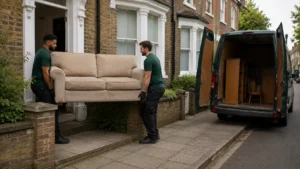
Yes. A sofa does not require a skip simply because it is large.
An unwanted sofa can potentially be donated if it remains suitable for reuse, booked into the council’s bulky item collection service or removed by a private waste collector.
Lewisham Council currently includes sofas among the large household items accepted through its bulky collection scheme.
The difficulty is often getting the sofa out of the property.
Large sofas may need to pass through narrow doorways, communal entrances or stairwells. Residents booking a private service should therefore explain where the sofa is located and whether there are any access difficulties.
Photographs can be useful when an item is unusually large.
How Can You Get Rid of an Old Wardrobe?
Wardrobes can be among the most awkward pieces of furniture to remove.
A large wardrobe may not fit through a doorway or staircase in one piece, meaning it may need to be dismantled before it can be taken away.
Before disposal, owners should consider whether the wardrobe remains usable. Someone else may be willing to collect it if it is in reasonable condition.
When a wardrobe is damaged or unsuitable for reuse, a furniture removal or bulky waste service can usually be considered.
Customers arranging a private collection should mention whether the wardrobe:
- Is upstairs
- Is already dismantled
- Is freestanding or fitted
- Contains mirrors or glass
- Is particularly heavy
- Has difficult access
Providing these details can reduce unexpected problems when the collection team arrives.
How Do You Get Rid of an Old Bed?
Old beds can normally be separated into a bed frame and mattress.
A dismantled bed frame is often considerably easier to carry and transport than an assembled one.
If the bed remains usable, reuse or donation may be worth considering first. Otherwise, residents can look at a bulky waste collection or private furniture removal.
Lewisham Council currently accepts beds and mattresses through its bulky-item arrangements, subject to its collection rules and current charges.
The mattress should also be mentioned separately when arranging a collection because it may be treated as an individual item.
What About Tables, Chairs and Cabinets?
Smaller furniture may appear easier to remove, but several tables, chairs, cabinets and shelving units can quickly fill a vehicle.
Where the items remain usable, selling or giving them away can prevent unnecessary disposal.
Damaged items can be grouped together for collection when using an appropriate rubbish removal service.
Typical furniture clearance jobs may involve:
- Dining tables
- Coffee tables
- Chairs
- Desks
- Cabinets
- Bookcases
- Shelving
- TV units
- Chests of drawers
- Bedside tables
- Storage furniture
When several items are being collected together, providing a complete list or photographs can make it easier to assess how much vehicle space will be required.
Can Furniture Be Donated Instead of Thrown Away?
Yes, and reuse should be considered when furniture remains in a suitable condition.
Lewisham Council provides information for residents who want to donate furniture and other household items and currently refers to free collection options for reusable goods.
Furniture offered for donation generally needs to be in a condition that makes it suitable for another household.
Individual organisations can have their own acceptance rules, particularly for:
- Upholstered furniture
- Mattresses
- Electrical furniture
- Damaged items
- Items with missing parts
- Large pieces that are difficult to collect
Residents should therefore check with the receiving organisation before assuming an item will be accepted.
Can You Sell Old Furniture Instead?
Selling unwanted furniture is another alternative to disposal.
Furniture that still has useful life may be listed through local marketplaces, second-hand selling platforms or community groups.
This can work particularly well for:
- Tables
- Chairs
- Wardrobes
- Desks
- Shelving
- Cabinets
- Garden furniture
- Storage units
A low price or free collection offer can sometimes make it easier to find someone willing to take a bulky item.
However, selling furniture is less practical when the property needs clearing immediately or the item is heavily damaged.
Can Furniture Be Given Away for Free?
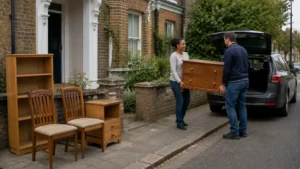
Giving usable furniture away can be faster than trying to sell it.
Local community groups and reuse platforms can connect unwanted items with people who are willing to collect them.
This approach can be useful when moving home, redecorating or replacing furniture and there is enough time to arrange collection.
Anyone giving furniture away should provide an accurate description of its size and condition so that the person collecting it knows what transport and lifting assistance will be required.
Can Old Furniture Be Taken to a Recycling Centre?
Depending on the type and size of the item, taking furniture to an appropriate reuse and recycling centre can be another alternative.
Lewisham Council operates the Landmann Way Reuse and Recycling Centre. Current access and quantity restrictions apply, including restrictions relating to larger items, so residents should check the latest rules before loading a vehicle and travelling there.
This approach is most suitable when someone has:
- Suitable transport
- Help loading furniture
- A manageable number of items
- Furniture accepted by the centre
It is unlikely to be convenient for someone clearing several rooms or trying to move a heavy sofa from an upstairs flat.
What Is the Easiest Option If You Do Not Have a Car?
People without a car or van generally have fewer DIY disposal options.
Transporting a sofa, bed or large cabinet on public transport is obviously impractical, while hiring a vehicle still means loading and unloading the furniture personally.
The main alternatives are therefore usually:
- Donation collection
- Council bulky waste collection
- Private furniture removal
- Full property clearance
Which option works best depends largely on whether the furniture can be moved outside and whether it is still reusable.
How Can You Get Furniture Removed From a Flat?
Removing furniture from a flat often requires more planning than clearing a house with direct road access.
Before arranging collection, residents should consider:
- Which floor the property is on
- Whether a lift is available
- The width of the staircase
- Communal access
- Building management rules
- Loading restrictions
- Parking
- Distance to the collection vehicle
A sofa that fits easily inside a ground-floor house can be a considerably more complicated removal when it is on the fourth floor of a converted building.
Providing accurate access details during booking allows the collector to understand what the job involves.
What Is the Best Way to Clear Several Pieces of Furniture?
When an entire room or property needs clearing, treating every object as a separate disposal job can become inconvenient.
A typical house clearance might include:
- Sofa
- Armchairs
- Dining table
- Chairs
- Wardrobes
- Beds
- Mattresses
- Cabinets
- Shelving
- Boxes
- General household clutter
In this situation, a private rubbish clearance service may be more practical because several suitable items can potentially be loaded during the same visit.
Customers should provide photographs of the overall clearance where possible rather than sending only a photograph of the largest object.
This helps show the approximate quantity of material involved.
How Can Landlords Get Rid of Old Furniture?
Landlords and letting agents often need furniture removed between tenancies.
A furnished or partly furnished property may contain unwanted beds, mattresses, sofas, tables and other belongings when occupants move out.
Before disposing of possessions left by a former tenant, landlords should make sure they are entitled to treat the items as abandoned or unwanted rather than automatically discarding property that may still belong to somebody else.
Once disposal is appropriate, a clearance can be arranged before:
- Professional cleaning
- Decorating
- Repairs
- New furniture installation
- Property inspections
- New tenants moving in
For a large rental clearance, photographs and an inventory of the unwanted items can make quotation and scheduling easier.
Can Furniture Be Removed During a House Move?

Yes. In fact, moving home is often when households discover how much unwanted furniture they have accumulated.
Furniture should ideally be sorted before moving day so that unwanted items do not have to be transported to the new property simply to be disposed of later.
Residents can divide belongings into four broad groups:
Keep – Furniture going to the new property.
Sell – Items with second-hand value.
Donate – Usable items suitable for another household.
Dispose – Broken or unsuitable furniture requiring collection.
Organising these categories early can make the final property clearance considerably easier.
How Do You Get Rid of Furniture After Renovating?
Redecorating or refurbishing a home can lead to several large items being replaced at once.
A new bedroom may mean disposing of an old bed, mattress and wardrobe, while a living-room renovation may leave an unwanted sofa, shelving and cabinets.
If furniture is mixed with renovation debris such as timber, flooring, tiles or rubble, customers should explain this when arranging collection.
Construction and demolition waste can be subject to different handling requirements from ordinary household furniture, particularly where the waste arises from commercial work. GOV.UK distinguishes business and construction waste from ordinary household waste and sets separate duty-of-care requirements for commercial waste.
Can You Leave Old Furniture Beside the Bins?
Old furniture should not simply be left beside ordinary bins or abandoned on a pavement.
Waste dumped somewhere without an authorised disposal arrangement may amount to fly-tipping.
Residents should use a legitimate disposal route such as an authorised collection, reuse organisation or appropriate recycling facility.
Lewisham Council also states that bulky waste collection areas on council-managed estates are intended only for residents of those estates. Waste left there by people who are not entitled to use the facility can be treated as illegally dumped waste.
Why Is Using a Registered Waste Carrier Important?
Anyone paying a private business to remove unwanted furniture should check who is taking the waste.
Government waste-duty-of-care guidance explains that householders must take reasonable measures to ensure household waste is transferred to an authorised person. Old furniture and mattresses fall within the types of unwanted household materials covered by waste guidance.
The Environment Agency provides a public register that can be used to check registered waste carriers, brokers and dealers.
This is particularly important when considering informal offers from individuals advertising furniture or rubbish collection.
A very low collection price does not necessarily demonstrate that waste will be disposed of correctly.
The Environment Agency specifically advises people using waste collectors, including “man with a van” services, to check that the collector is registered before handing over waste.
What Information Should You Give a Furniture Removal Company?
Giving clear information before collection can help produce a more accurate quotation and ensure appropriate capacity is available.
Customers should normally explain:
- Number of items
- Type of furniture
- Approximate size
- Whether anything is exceptionally heavy
- Floor level
- Stair access
- Lift availability
- Parking arrangements
- Distance from property to vehicle
- Whether furniture is dismantled
Photographs can be particularly useful.
Instead of simply saying “some old furniture”, photographs can show whether the job involves two chairs and a table or an entire room of bulky furniture.
Should Furniture Be Dismantled Before Collection?
Dismantling furniture can sometimes make removal easier, but customers should check whether it is necessary.
Items such as bed frames, tables and wardrobes may be easier to move when separated into smaller sections.
However, dismantling is not appropriate for every item and could create additional sharp edges, broken glass or unstable components.
If a collection company offers dismantling as part of the service, customers may prefer to leave larger items intact and explain the situation when booking.
Council Collection or Private Furniture Removal?
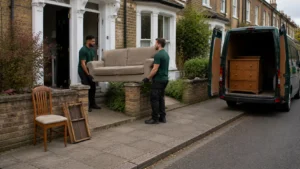
Both can be suitable alternatives to hiring a skip.
Council Collection
Lewisham Council’s bulky collection may be a good choice when:
- There are only a few items
- The items are accepted
- The resident can move them outside
- Collection timing is suitable
- Indoor loading is not needed
Current Lewisham Council charges start at £5 per standard large household item, although residents should confirm the latest pricing when booking.
Private Furniture Removal
Private collection may be more appropriate when:
- Several items need clearing
- Furniture is inside the property
- Items need carrying downstairs
- A flat has difficult access
- Furniture is mixed with other suitable rubbish
- Greater scheduling flexibility is required
- A larger property clearance is needed
The customer should check what is included in the quotation and confirm that the collector is appropriately authorised to carry waste.
Skip Hire or Furniture Collection: Which Is More Convenient?
The answer depends on the job.
A skip can make sense when a large project will generate waste gradually over several days and there is a suitable place for the container.
A furniture collection is often more convenient when the rubbish already exists and simply needs to be removed.
With an appropriate collection service, the furniture can be loaded and taken away during the booked visit rather than leaving a skip outside the property until collection.
This can be particularly useful for:
- House moves
- End-of-tenancy clearances
- Furniture replacements
- Landlord clearances
- Flat clearances
- Office moves
- Decluttering projects
How to Prepare Old Furniture for Collection?
A little preparation can make furniture removal considerably easier.
Start by identifying exactly what needs to go.
Separate anything intended for donation or sale from genuine waste so that useful furniture is not accidentally removed.
Next, check access between the furniture and the collection point. Move small obstacles where practical and tell the collection company about stairs, narrow entrances or controlled access.
Customers should also:
- Empty cupboards and drawers
- Remove personal belongings
- Secure loose parts where appropriate
- Mention mirrors or glass
- Identify exceptionally heavy items
- Provide photographs
- Confirm parking or loading conditions
Accurate information is particularly important when furniture needs to be carried from an upper floor.
What Is the Cheapest Way to Get Rid of Old Furniture?
The cheapest method depends on the condition of the item.
Giving usable furniture away may cost nothing if someone is willing to collect it. Donation collection may also be available for suitable items.
For furniture that has become waste, Lewisham Council’s current £5-per-item bulky waste charge can provide an economical option for residents who can meet its collection requirements.
Private furniture removal usually costs more because the service may involve vehicle capacity, transport, loading labour, access and disposal costs.
However, comparing only the price per item can be misleading when several pieces need to be carried from inside a property.
The most suitable option should therefore be based on both cost and the service actually required.
What Is the Best Alternative to Hiring a Skip?
There is no single alternative that suits every household.
For furniture that remains usable, donation, selling or giving it away should usually be considered first.
For a small number of damaged items that can be moved outside, a council bulky collection may be sufficient.
For people with suitable transport, an appropriate reuse and recycling centre may be practical.
For several pieces of furniture, difficult access or items that need to be collected from inside a property, private rubbish removal can provide a more convenient solution.
The key is to choose a disposal method that matches the quantity of furniture, the property’s access and the condition of the items.
Conclusion
Hiring a skip is far from the only way to get rid of old furniture.
Usable sofas, tables, wardrobes and other items may be suitable for donation, resale or reuse. Furniture that has reached the end of its useful life can be handled through Lewisham Council’s bulky waste service, an appropriate recycling centre or an authorised private rubbish removal company.
The most convenient choice depends on how much furniture needs removing, whether it is still usable, where it is located and whether someone can safely carry it outside.
For larger clearances or furniture that needs removing directly from inside a house or flat, a collection service can offer a practical alternative to hiring, loading and managing a skip.
Frequently Asked Questions
Can I Get Rid of a Sofa Without Hiring a Skip?
Yes. A sofa can potentially be donated, collected through Lewisham Council’s bulky waste service or removed by an authorised private waste collector. Lewisham Council currently accepts sofas through its bulky-item collection scheme.
How Can I Get Rid of Furniture If I Do Not Have a Car?
Residents without suitable transport can consider charity or reuse collections, council bulky waste collection or a private furniture removal service.
Does Lewisham Council Collect Old Furniture?
Yes. Lewisham Council currently provides a bulky item collection service covering household furniture such as sofas, chairs and beds.
Will the Council Carry My Sofa Downstairs?
No. Lewisham Council states that its collectors do not remove bulky items from inside a property or help carry them outside.
Can I Donate Old Furniture in Lewisham?
Yes, provided the furniture is suitable for reuse and meets the receiving organisation’s requirements. Lewisham Council provides specific guidance on donating furniture and other reusable household items.
Can Old Furniture Be Left Next to Household Bins?
Furniture should not simply be abandoned beside bins or on the pavement. It should be removed through an authorised waste, recycling or reuse route.
Do Private Furniture Collectors Need to Be Registered?
Householders using a private waste collector should take reasonable steps to ensure the waste is handed to an authorised person. The Environment Agency maintains a public register of waste carriers, brokers and dealers that can be checked before collection.